Samsung’s Galaxy Z foldable phones are changing shape. The Galaxy Z Fold8 Ultra continues the classic premium book-style Fold formula and effectively succeeds the Galaxy Z Fold7, while the standard Galaxy Z Fold8 introduces a shorter, wider “passport-style” design aimed at reading, browsing, gaming and everyday two-handed use. The Galaxy Z Fold7 remains the immediate predecessor and a useful benchmark because it already delivered an 8-inch main screen, 200 MP camera and ultra-thin body. The table below focuses on technical specifications only, so the differences are easy to compare at a glance.
The Galaxy Z Fold8 Ultra is the true technical successor to the Galaxy Z Fold7, keeping the familiar tall Fold body while upgrading the processor, main-display resolution, battery capacity, Bluetooth version and ultrawide camera.
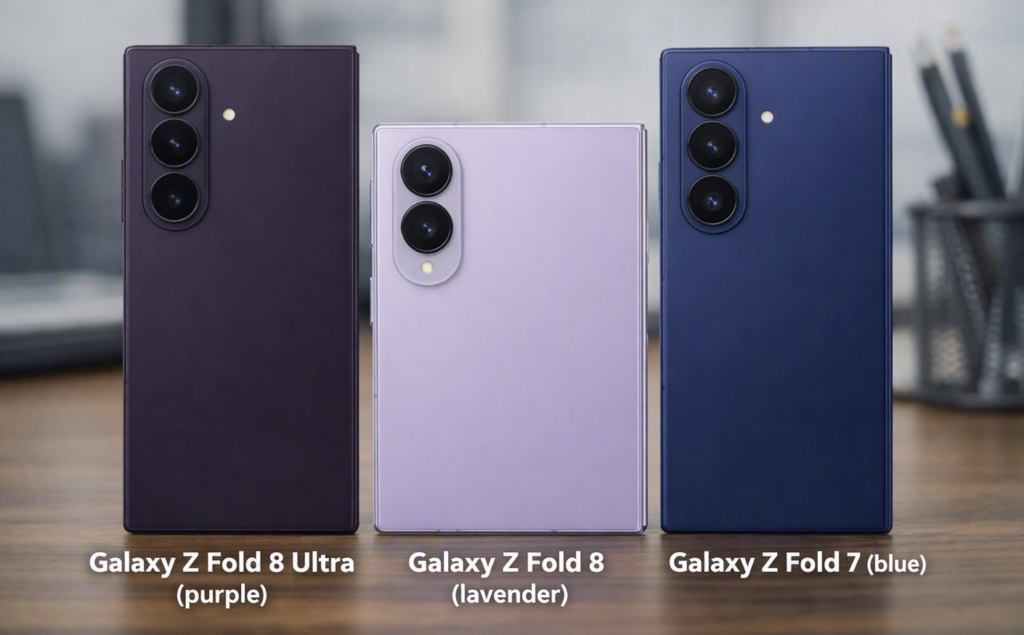
Technical Specifications Comparison
| Specification | Galaxy Z Fold8 (2026) | Galaxy Z Fold8 Ultra (2026) | Galaxy Z Fold7 (2025) |
| Position in line-up | New wider, shorter Fold model positioned below Ultra | Premium Fold model and direct successor to the classic Z Fold line | 2025 flagship Fold predecessor |
| Launch generation | 2026 Galaxy Z Fold8 series | 2026 Galaxy Z Fold8 series | 2025 Galaxy Z Fold7 series |
| Form factor | Book-style foldable with wider “passport-style” proportions | Book-style foldable with taller classic Fold proportions | Book-style foldable with classic Fold proportions |
| Main display size | 193.2 mm / 7.6-inch full rectangle; 192.5 mm / 7.6-inch rounded corners | 203.1 mm / 8.0-inch full rectangle; 202.4 mm / 8.0-inch rounded corners | 203.1 mm / 8.0-inch full rectangle; 202.4 mm / 8.0-inch rounded corners |
| Main display resolution | 1848 x 2448 QXGA+ | 2504 x 2256 QXGA+ | 2184 x 1968 QXGA+ |
| Main display technology | Dynamic AMOLED 2X, 16M colours | Dynamic AMOLED 2X, 16M colours | Dynamic AMOLED 2X, 16M colours |
| Main display refresh rate | Up to 120 Hz | Up to 120 Hz | Up to 120 Hz |
| Cover display size | 138.4 mm / 5.5-inch full rectangle; 137.5 mm / 5.4-inch rounded corners | 164.8 mm / 6.5-inch full rectangle; 164.1 mm / 6.5-inch rounded corners | 164.8 mm / 6.5-inch full rectangle; 164.2 mm / 6.5-inch rounded corners |
| Cover display resolution | 1972 x 1248 WUXGA+ | 2520 x 1080 FHD+ | 2520 x 1080 FHD+ |
| Cover display technology | Dynamic AMOLED 2X, 16M colours | Dynamic AMOLED 2X, 16M colours | Dynamic AMOLED 2X, 16M colours |
| Processor CPU speed | 4.74 GHz, 3.6 GHz | 4.74 GHz, 3.6 GHz | 4.47 GHz, 3.5 GHz |
| CPU type | Octa-core | Octa-core | Octa-core |
| Chipset family | Snapdragon 8 Elite Gen 5 for Galaxy, as reported for the Fold8 line | Snapdragon 8 Elite Gen 5 for Galaxy, as reported for the Fold8 line | Snapdragon 8 Elite for Galaxy |
| Memory | 12 GB RAM | 12 GB RAM on 256 GB and 512 GB variants; 16 GB RAM on 1 TB variant in reported configuration details | 12 GB RAM; 16 GB RAM available on selected 1 TB configuration in some markets |
| Storage options | 256 GB, 512 GB, 1 TB | 256 GB, 512 GB, 1 TB | 256 GB, 512 GB, 1 TB |
| Expandable storage | No microSD expansion | No microSD expansion | No microSD expansion |
| Rear camera system | Dual camera: 50 MP wide + 50 MP ultrawide | Triple camera: 200 MP wide + 50 MP ultrawide + 10 MP telephoto | Triple camera: 200 MP wide + 12 MP ultrawide + 10 MP telephoto |
| Rear camera apertures | F1.8 wide, F1.9 ultrawide | F1.7 wide, F1.9 ultrawide, F2.4 telephoto | F1.7 wide, F2.2 ultrawide, F2.4 telephoto |
| Rear camera autofocus | Yes | Yes | Yes |
| Rear camera OIS | Yes | Yes | Yes |
| Zoom | 2x optical-quality zoom using Adaptive Pixel sensor; digital zoom up to 10x | 3x optical zoom; 2x optical-quality zoom using Adaptive Pixel sensor; digital zoom up to 30x | 3x optical zoom; 2x optical-quality zoom using Adaptive Pixel sensor; digital zoom up to 30x |
| Front camera | 10 MP, F2.2, fixed focus | 10 MP, F2.2, fixed focus | 10 MP, F2.2, fixed focus |
| Cover camera | 10 MP, F2.2, fixed focus | 10 MP, F2.2, fixed focus | 10 MP, F2.2, fixed focus |
| Rear flash | Yes | Yes | Yes |
| Video recording | UHD 8K at 30 fps | UHD 8K at 30 fps | UHD 8K at 30 fps |
| Slow motion | 240 fps at FHD; 120 fps at FHD; 120 fps at UHD | 240 fps at FHD; 120 fps at FHD; 120 fps at UHD | 240 fps at FHD; 120 fps at FHD; 120 fps at UHD |
| Battery capacity | 4,800 mAh | 5,000 mAh | 4,400 mAh |
| Wired charging | 45 W wired charging, reported for Fold8 | 45 W wired charging, reported for Fold8 Ultra | 25 W wired charging |
| Wireless charging | Wireless charging supported | Fast wireless charging supported | 15 W wireless charging |
| Reverse wireless charging | Supported | Wireless PowerShare supported | 4.5 W reverse wireless charging |
| Folded dimensions | 123.9 x 81.9 x 9.7 mm | 158.4 x 72.8 x 8.9 mm | 158.4 x 72.8 x 8.9 mm |
| Unfolded dimensions | 123.9 x 161.4 x 4.5 mm | 158.4 x 143.2 x 4.1 mm | 158.4 x 143.2 x 4.2 mm |
| Weight | 201 g | 215 g | 215 g |
| SIM support | Nano-SIM and eSIM | Nano-SIM and eSIM | Nano-SIM and eSIM |
| Network support | 2G GSM, 3G WCDMA, 4G LTE FDD/TDD, 5G Sub6 FDD/TDD | 2G GSM, 3G WCDMA, 4G LTE FDD/TDD, 5G Sub6 FDD/TDD | 2G GSM, 3G WCDMA, 4G LTE FDD/TDD, 5G Sub6 FDD/TDD |
| Wi-Fi | 802.11 a/b/g/n/ac/ax/be, 2.4 GHz + 5 GHz + 6 GHz, EHT320, MIMO, 4096-QAM | 802.11 a/b/g/n/ac/ax/be, 2.4 GHz + 5 GHz + 6 GHz, EHT320, MIMO, 4096-QAM | 802.11 a/b/g/n/ac/ax/be, 2.4 GHz + 5 GHz + 6 GHz, EHT320, MIMO, 4096-QAM |
| Bluetooth | Bluetooth v6.0 | Bluetooth v6.0 | Bluetooth v5.4 |
| USB | USB Type-C, USB 3.2 Gen 1 | USB Type-C, USB 3.2 Gen 1 | USB Type-C, USB 3.2 Gen 1 |
| NFC | Yes | Yes | Yes |
| UWB | Yes | Yes | Yes |
| Location technology | GPS, Glonass, Beidou, Galileo, QZSS | GPS, Glonass, Beidou, Galileo, QZSS | GPS, Glonass, Beidou, Galileo, QZSS |
| Earjack | USB Type-C | USB Type-C | USB Type-C |
| Water and dust resistance | IP48 | IP48 | IP48 |
| Biometrics | Side fingerprint scanner | Side fingerprint scanner | Side fingerprint scanner |
| Software at launch | Android 17 with One UI 9 and Galaxy AI, as reported for the 2026 Fold line | Android 17 with One UI 9 and Galaxy AI, as reported for the 2026 Fold line | Android 16 with One UI 8 and Galaxy AI |
| Colours | Lavender, Graphite, Cream, Pistachio | Violet Shadow, Graphite, Cream, Green Shadow | Blue Shadow, Silver Shadow, Jetblack, Mint |
| Core technical advantage | Lightest body and widest Fold8 shape for reading, gaming and everyday portability | Highest-resolution main display, largest battery, upgraded ultrawide camera and fastest Fold8 performance tier | Strong predecessor with 8-inch display, 200 MP camera and classic Fold proportions |
Although the Galaxy Z Fold 8 is described as being slightly thinner than the Galaxy Z Fold 7, the official Samsung website lists their folded dimensions as exactly the same.
The Galaxy Z Fold8 is the biggest design departure this year: it is lighter and much wider when folded, with a smaller 7.6-inch main screen and a dual-camera system.
The Galaxy Z Fold7 still compares strongly on display size, weight, camera resolution and classic Fold proportions, but the Fold8 Ultra is the clearest upgrade for buyers who want the highest specifications, while the standard Fold8 is the better choice for those who value the new shape and lighter handling over maximum camera hardware.
Key Differences Between Galaxy Z Fold7 and the Fold8 Generation
- Two-model Fold8 strategy: The Galaxy Z Fold7 was a single flagship Fold model, while the Fold8 generation splits the line into the standard Galaxy Z Fold8 and the higher-end Galaxy Z Fold8 Ultra. This makes the Fold8 range less of a one-for-one replacement and more of a choice between a lighter new shape and a classic Ultra upgrade.
- Different body shapes: The Galaxy Z Fold8 introduces a shorter, wider passport-style design, while the Galaxy Z Fold8 Ultra keeps the taller classic Fold shape used by the Galaxy Z Fold7. This means the standard Fold8 feels more different in hand, while the Ultra feels more like a refined Fold7 successor.
- Display direction changes: The Fold8 Ultra keeps the 8.0-inch main display size of the Fold7 but moves to a higher-resolution 2504 x 2256 panel. The standard Fold8 uses a smaller 7.6-inch main display but changes the aspect ratio to prioritise wider reading, gaming and browsing layouts.
- Performance improves on both Fold8 models: The Fold8 and Fold8 Ultra move from the Galaxy Z Fold7’s Snapdragon 8 Elite for Galaxy to the newer Snapdragon 8 Elite Gen 5 for Galaxy, with higher listed CPU speeds in the comparison table.
- Battery capacity increases: The Galaxy Z Fold7 has a 4,400 mAh battery, while the standard Fold8 rises to 4,800 mAh and the Fold8 Ultra rises to 5,000 mAh. This is one of the clearest technical upgrades from the Fold7 generation.
- Charging is faster on Fold8 models: The Fold7 lists 25 W wired charging, while both Fold8 models are listed with 45 W wired charging. That makes the Fold8 generation better suited to quick top-ups during heavy use.
- Camera strategy splits: The Fold8 Ultra improves on the Fold7’s camera set by keeping the 200 MP main camera and telephoto lens while upgrading the ultrawide camera from 12 MP to 50 MP. The standard Fold8 goes in a different direction with a simpler dual-camera system: 50 MP wide plus 50 MP ultrawide, but no dedicated telephoto lens.
- Zoom differs sharply: The Fold7 and Fold8 Ultra both offer 3x optical zoom and up to 30x digital zoom, while the standard Fold8 is limited to 2x optical-quality zoom and up to 10x digital zoom.
- Weight and portability shift: The standard Fold8 is lighter at 201 g, making it the most portable of the three. The Fold8 Ultra and Fold7 are both listed at 215 g, so the Ultra improves specs without reducing weight compared with the Fold7.
- Connectivity gets a Bluetooth upgrade: The Fold8 models list Bluetooth v6.0, while the Fold7 lists Bluetooth v5.4. Wi-Fi, USB-C, NFC, UWB and major network support remain broadly similar across all three.
- Software generation moves forward: The Fold8 models are listed with Android 17, One UI 9 and Galaxy AI, while the Fold7 launched with Android 16, One UI 8 and Galaxy AI. The Fold8 generation therefore starts one software generation ahead.
- The upgrade choice depends on priorities: Choose the Fold8 Ultra over the Fold7 for the clearest technical upgrade: newer processor, bigger battery, faster charging, improved ultrawide camera and higher-resolution main display. Choose the standard Fold8 if the priority is a lighter, wider and more portable foldable rather than matching the Fold7’s camera and screen size.