Staying connected in Australia is simple once you know what to look for. Whether you are visiting for a few days, planning a road trip or settling in for a working holiday, a local SIM or eSIM can provide reliable data, local calls and easy access to maps, transport apps and bookings. Here is what first-time visitors need to know before choosing a plan.
Australia’s Mobile Networks: What Travellers Need to Know
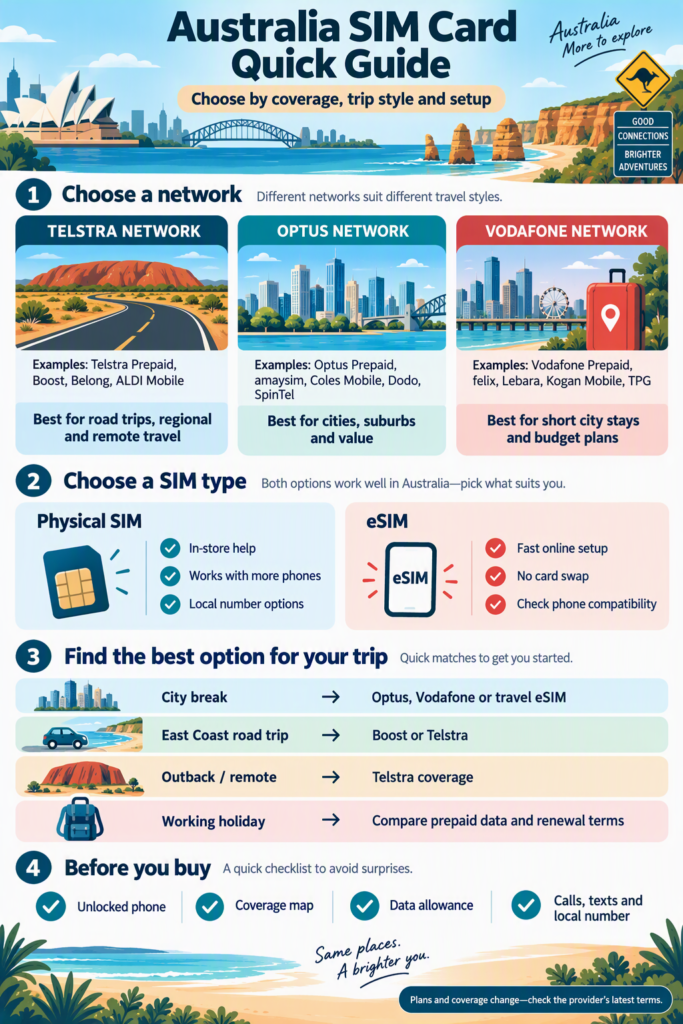
Australia has three main mobile networks:
| Network | SIM brands and providers | Coverage | Best For |
| Telstra | Telstra Prepaid, Boost Mobile, Belong, ALDI Mobile, Everyday Mobile from Woolworths, Tangerine, Pennytel, MATE, More, Exetel and Superloop | Widest coverage (cities + remote areas) | Road trips, Outback, regional travel |
| Optus | Optus Prepaid, amaysim, Coles Mobile, Dodo, iPrimus, Aussie Broadband, AGL Mobile, OnePass Mobile, SpinTel, Yomojo and Southern Phone | Strong metro & suburban coverage | City‑based travel |
| Vodafone | Vodafone Prepaid, TPG, iiNet, Internode, felix mobile, Lebara, Kogan Mobile, Lycamobile and Moose Mobile | Cheapest, metro‑focused | Short stays in major cities |
Most prepaid providers operate on one of these three networks, so compare the underlying network—not just the brand name—when choosing a plan.
Best SIM Card Options for Travellers
1. Boost Mobile (Telstra network)
Best all-round option for broad coverage
- Uses the full Telstra network (99.7% coverage)
- Great for road trips, coastal drives, and regional attractions
- Affordable prepaid plans with generous data
Ideal for: Travellers visiting multiple states or remote areas.
2. amaysim (Optus network)
Best value for longer stays
- Large data allowances
- Unlimited international calls to selected countries
- Supports eSIM
- Easy online activation
Ideal for: Digital nomads, working holiday travellers, city‑based trips.
3. Travel eSIMs (Airalo, Holafly and Nomad)
Best for short stays or instant setup
- Activate before landing
- No physical SIM needed
- Cheap data‑only plans
Keep in mind: Many travel eSIMs are data-only and do not include an Australian phone number, which may matter if you need to make local calls or receive SMS verification codes.
4. Telstra, Optus or Vodafone prepaid
Best for walk‑in convenience
- Available at airports and shopping centres
- Unlimited calls/text
- Flexible recharge options
Ideal for: Travellers who prefer buying in person.
Where to Buy a SIM Card in Australia
At the airport
Available at:
- Telstra, Optus, Vodafone kiosks
- 7‑Eleven, WHSmith, airport convenience stores
Pros: You can get connected immediately and ask staff for help. Cons: Airport offers may be more expensive or provide fewer choices.
In the city
Buy from:
- Coles & Woolworths supermarkets
- 7‑Eleven
- Australia Post
- Telstra/Optus/Vodafone stores
Pros: You will usually find more plans and promotions. Cons: You may need Wi-Fi or another way to navigate before you are connected.
Online: eSIM or physical SIM
Providers such as amaysim, Airalo, Holafly and Nomad offer online purchase and activation. An eSIM can be especially convenient if you want mobile data ready as soon as you arrive.
Best for: Travellers who want connectivity the moment they land.
Physical SIM vs eSIM: Which Is Right for You?
Choose a physical SIM if you:
- have a phone without eSIM support
- want to buy and activate your service in a store
- prefer help from staff during setup
Choose an eSIM if you:
- want to activate your plan before or soon after arrival
- do not want to swap physical SIM cards
- have a compatible unlocked phone
Before buying: Check that your phone supports eSIM and is unlocked. Provider support and activation requirements can vary.
Which SIM Is Best for Your Trip?
City‑Only Travel (Sydney, Melbourne, Brisbane, Perth) – Choose: amaysim, Optus, Vodafone, or travel eSIM
East Coast Road Trip – Choose: Boost Mobile or Telstra Prepaid
Outback / Remote Travel (Uluru, NT, WA regions) – Choose: Telstra Prepaid
Short Stay (3–10 days) – Choose: Travel eSIM
Long Stay / Working Holiday – Choose: amaysim or Telstra Prepaid
Practical Setup Tips for Travellers
- Make sure your phone is unlocked
- Bring your passport for identity verification
- Avoid PAYG — prepaid bundles offer better value
- Check your phone supports Australian 4G/5G bands
- Activate eSIM before arrival if you want instant connectivity
Final Takeaway
Getting connected in Australia does not need to be complicated. Choose a provider based on where you are travelling, how long you are staying and whether you need a local phone number. For city breaks, several budget-friendly options can work well; for regional drives or remote itineraries, prioritise network coverage over price. Check current plan inclusions, coverage maps and activation requirements before you buy, then download your essential travel apps and enjoy the trip.