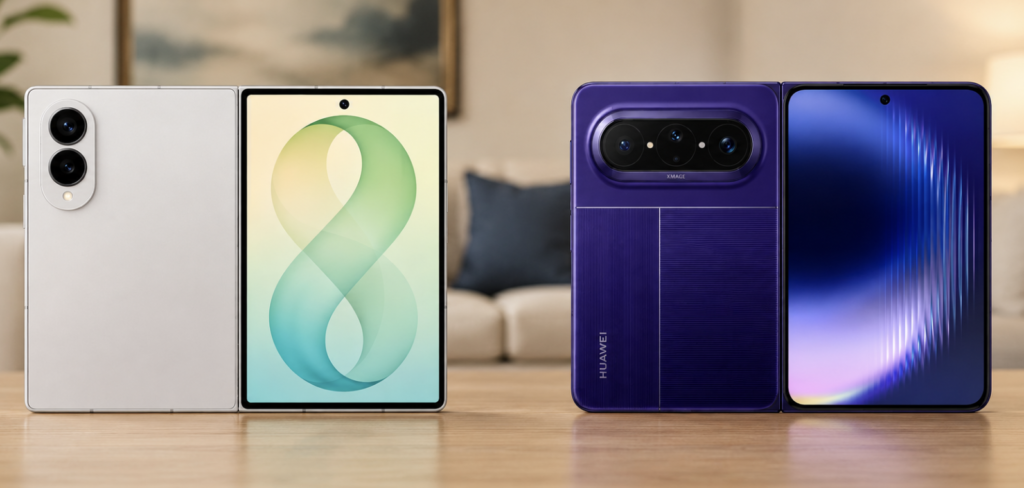
The Samsung Galaxy Z Fold8 and HUAWEI Pura X Max both target users who want more screen space than a traditional smartphone can offer, but they approach the foldable idea in very different ways. Samsung’s Galaxy Z Fold8 is a lighter, 7.7 inch inner display, more globally available book-style foldable built around Galaxy AI, strong performance and a balanced everyday form factor. Huawei’s Pura X Max takes a wider, more experimental approach, pairing a 7.7-inch inner display with HarmonyOS, XMAGE imaging, stylus support and a larger battery.
For buyers, the choice is not only about which phone has the biggest screen. It is about software ecosystem, camera priorities, portability, charging, app support, price and where the device is actually available. The Galaxy Z Fold8 is the safer mainstream choice for most global buyers, while the Pura X Max is the more distinctive option for users who specifically want Huawei’s wide-screen format and camera hardware.
Design and Portability
The Galaxy Z Fold8 is the lighter phone, weighing 201 g compared with the Pura X Max at about 229 g. Samsung’s foldable is also slimmer when folded, measuring 9.7 mm thick compared with Huawei’s 11.2 mm. That makes the Galaxy Z Fold8 easier to carry and more practical for people who want a foldable that still feels close to a normal phone in the pocket.
The Pura X Max is wider and more substantial, but that is also its defining feature. Its unfolded width of 166.5 mm gives it a broader canvas than Samsung’s 123.9 mm unfolded width. If the priority is comfortable one-handed portability, Samsung has the advantage. If the priority is a bigger, more horizontal workspace, Huawei is more distinctive.
Display Experience
Samsung uses a 7.6-inch main Dynamic AMOLED 2X display and a 5.5-inch cover display. Both are designed around modern content ratios, with the Fold8’s 10:16 folded experience suited to social feeds and its 4:3 unfolded screen suited to reading, movies and e-books. Samsung also emphasises 3000 nits of brightness and anti-reflection on the main display.
Huawei’s Pura X Max has a slightly larger 7.7-inch inner foldable OLED display and a 5.4-inch outer OLED display. Both support LTPO 2.0 adaptive refresh rates from 1–120 Hz, wide colour and high-frequency PWM dimming. The Huawei display setup is especially appealing if you want a wider unfolded screen for video editing, reading, browsing and stylus work.
Performance and Software
The Galaxy Z Fold8 runs Android 17 and uses Snapdragon 8 Elite Gen 5 for Galaxy, giving it a strong performance foundation and broad app compatibility. Galaxy AI, Gemini Intelligence, Multi Window, App Continuity and Taskbar features make the software feel well adapted to foldable multitasking.
The HUAWEI Pura X Max runs HarmonyOS 6.1 and focuses on Huawei’s own AI and big-screen software experience. It can be powerful and polished inside Huawei’s ecosystem, but international buyers should remember that app availability and Google service support can be a major consideration depending on region and import model.
Cameras
The Pura X Max has the more ambitious camera system on paper. It combines a 50 MP variable-aperture main camera, a 12.5 MP ultra-wide camera, a 50 MP periscope telephoto camera and a Red Maple primary-colour camera. Its zoom range includes 3.5x optical zoom, 7x optical-quality zoom and up to 100x digital zoom.
The Galaxy Z Fold8 takes a simpler dual-camera route with 50 MP wide and 50 MP ultra-wide cameras, plus 10 MP front and cover cameras. It still offers 8K video recording and optical-quality 2x zoom, but Huawei clearly has the broader imaging toolkit if telephoto reach and camera experimentation are priorities.
Battery and Charging
Huawei has the larger battery and faster charging package. The Pura X Max includes a 5300 mAh typical battery, 66 W wired charging and 50 W wireless charging. The Galaxy Z Fold8 has a 4800 mAh battery and is positioned around up to 26 hours of streaming, but its article specifications do not list the same level of fast-charging advantage as Huawei’s foldable.
Availability and Buying Practicality
The Galaxy Z Fold8 has the stronger global buying case. It is listed through major retail and carrier channels in multiple markets, with clear storage tiers and local pricing in regions such as Australia. The Pura X Max is primarily a China-market product at launch, and buyers outside China may need to rely on import channels. That can affect warranty, service, language support, network compatibility and app access.
Detailed Specifications Comparison
| Category | Samsung Galaxy Z Fold8 | HUAWEI Pura X Max |
| Foldable style | Book-style foldable with shorter, wider everyday form factor. | Wide-folding foldable with a broader unfolded canvas. |
| Operating system | Android 17. | HarmonyOS 6.1. |
| Processor | Octa-core processor, CPU speeds listed at 4.74 GHz and 3.6 GHz; Snapdragon 8 Elite Gen 5 for Galaxy in product messaging. | Huawei platform with HarmonyOS 6.1 |
| Dimensions | Unfolded: 123.9 × 161.4 × 4.5 mm. Folded: 123.9 × 81.9 × 9.7 mm. | Unfolded: 166.5 × 120 × 5.2 mm. Folded: 85 × 120 × 11.2 mm. |
| Weight | 201 g. | About 229 g including battery. |
| Main display | 7.6-inch Dynamic AMOLED 2X, 1848 × 2448 QXGA+, 120 Hz maximum refresh rate, 16M colour depth. | 7.7-inch foldable flexible OLED, 2584 × 1828, 1.07 billion colours, P3 wide colour gamut, 1–120 Hz LTPO 2.0, 1440 Hz PWM dimming, up to 240 Hz touch sampling. |
| Cover display | 5.5-inch Dynamic AMOLED 2X, 1972 × 1248 WUXGA+, 16M colour depth. | 5.4-inch OLED, 1848 × 1264, 1.07 billion colours, P3 wide colour gamut, 1–120 Hz LTPO 2.0, 1440 Hz PWM dimming, up to 300 Hz touch sampling. |
| Display protection | Flex Titanium and durability-focused foldable construction highlighted in product messaging. | Second-generation Kunlun Glass on the outer display; foldable flexible screen with UTG inside. |
| Rear cameras | 50 MP + 50 MP dual rear camera system; F1.8 and F1.9 apertures; autofocus, OIS and flash supported. | 50 MP variable-aperture main camera, 12.5 MP ultra-wide camera, 50 MP periscope telephoto camera and second-generation Red Maple primary-colour camera. |
| Zoom | Optical-quality 2x zoom enabled by Adaptive Pixel sensor; digital zoom up to 10x. | 3.5x optical zoom, 7x optical-quality zoom and up to 100x digital zoom. |
| Front cameras | 10 MP front camera and 10 MP cover camera, both F2.2 and no autofocus. | 8 MP outer front camera with F2.4 aperture and 8 MP inner front camera with F2.2 aperture. |
| Video recording | UHD 8K at 30 fps. Slow motion supports 240 fps at FHD, 120 fps at FHD and 120 fps at UHD. | Rear video up to 3840 × 2160, with HDR Vivid and stabilisation features depending on mode. |
| Memory and storage | 12 GB + 256 GB, 12 GB + 512 GB and 16 GB + 1 TB options. No expandable memory. | 12 GB + 256 GB, 12 GB + 512 GB, 16 GB + 512 GB Collector’s Edition and 16 GB + 1 TB Collector’s Edition. No memory card expansion. |
| Battery | 4800 mAh battery capacity. | 5300 mAh typical capacity; 5150 mAh rated capacity. |
| Charging | USB Type-C charging; charging adapter not included in the box. | Up to 66 W wired HUAWEI SuperCharge, 50 W wireless HUAWEI SuperCharge, wireless reverse charging and 5 W wired reverse charging. |
| SIM and eSIM | Nano-SIM and embedded SIM. | Physical SIM and eSIM support, with up to four numbers stored and two active numbers depending on carrier support. |
| Wi-Fi | Wi-Fi 802.11a/b/g/n/ac/ax/be, 2.4 GHz + 5 GHz + 6 GHz, EHT320, MIMO and 4096-QAM. | 2.4 GHz and 5 GHz IEEE 802.11a/b/g/n/ac/ax/be, 2 × 2 MIMO, EHT160 and 8 spatial-stream sounding MU-MIMO. |
| Bluetooth | Bluetooth v6.0. | Bluetooth 6.0 with Bluetooth Low Energy and SBC, AAC and LDAC audio support. |
| NFC | Yes. | Supported. |
| UWB / infrared | Ultra-Wideband supported. | Infrared remote control supported; UWB not listed in the Huawei table. |
| Water and dust resistance | Durability-focused construction highlighted; detailed IP rating not included in the current article’s specification table. | IP58 and IP59 splash, water and dust resistance under controlled test conditions. |
| Stylus support | No S Pen support noted in the article’s comparison with previous Fold models. | Supports HUAWEI M-Pen 3 Mini, sold separately. |
| Availability | Broader global availability through official and retail channels. | Primarily China-market availability, with import options outside China through local retailers. |
Which Phone Should You Choose?
Choose the Samsung Galaxy Z Fold8 if you want a lighter foldable, wider global availability, Android app compatibility, Galaxy AI, 8K video recording and a more familiar book-style experience. It is the more practical pick for most people, especially if warranty, service support and app access matter.
Choose the HUAWEI Pura X Max if you want a larger and wider inner display, more ambitious zoom hardware, faster listed charging, a bigger battery, stylus support and Huawei’s distinctive wide-screen foldable format. It is the more adventurous choice, but it also comes with more questions around international availability and app ecosystem support.
The Samsung Galaxy Z Fold8 is the better all-round foldable for buyers who want a premium, powerful and globally practical device. It is lighter, easier to buy in more regions and better suited to users who depend on Android apps and mainstream support.
The HUAWEI Pura X Max is the more unusual and creatively focused foldable. Its wider display, bigger battery, stylus support and stronger telephoto camera system make it compelling for media, reading, sketching and photography-focused users. However, its China-first availability and ecosystem considerations make it a more specialised purchase. In short, the Galaxy Z Fold8 is the safer recommendation; the Pura X Max is the more distinctive foldable for users willing to accept trade-offs.