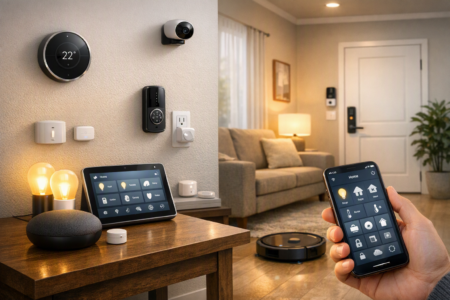
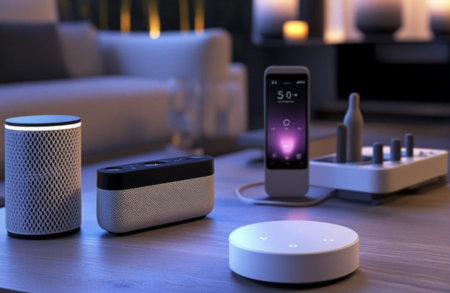
The Google Home Speaker 2026 is Google’s refreshed standalone smart speaker, built around Gemini for Home rather than the older Google Assistant experience. It is designed for everyday voice help, music, podcasts, timers, smart home control, broadcasts, and more natural conversations in the home. Google positions it as a compact, affordable smart speaker that also works as a hub for connected devices through Matter and Thread support.
Its biggest appeal is the shift from simple command-and-response voice control to more conversational AI. Users can speak more naturally, give multiple instructions in one request, correct themselves mid-sentence, and use Gemini for richer answers.
The speaker also brings a new rounded fabric design, 360-degree sound, a base light ring, far-field microphones, privacy controls, and compatibility with Google Home, Google TV Streamer, Cast speaker groups, and supported smart home ecosystems.
Colours and Variants Available
The Google Home Speaker 2026 is offered in four colours globally: Porcelain, Hazel, Jade, and Berry. Porcelain and Hazel are the broadest international colours, while Jade and Berry may be limited to selected markets such as the United States. The colour options are designed to blend into home décor rather than look like traditional black-box speakers.
Unlike many phones or laptops, the Google Home Speaker is not separated into storage or performance tiers. There is one core hardware model, with differences mainly coming from colour availability, regional pricing, and whether the buyer chooses to subscribe to Google Home Premium for extra Gemini Live and advanced home features.
Key Features
- Gemini for Home: A more natural voice assistant that understands conversational requests, multi-step commands, and follow-up questions.
- 360-degree sound: Designed to spread audio evenly around a room for music, podcasts, alarms, and media playback.
- Compact rounded design: A small fabric-covered speaker with a soft, home-friendly shape and a glowing base light ring.
- Far-field microphones: Three microphones help the speaker hear voice requests from across the room.
- Physical microphone mute: A hardware mute switch gives users a clear privacy control when they do not want the microphones active.
- Smart home hub support: Matter and Thread support help the speaker act as a central point for compatible connected devices.
- Google TV Streamer pairing: Two speakers can be paired with a Google TV Streamer for a more immersive TV audio setup.
- Speaker groups and Cast: Works with supported Nest speakers, displays, and Cast devices for multi-room audio.
Detailed Specifications
| Category | Google Home Speaker 2026 Specification |
| Finish | Fabric-covered rounded design in Porcelain, Hazel, Jade and Berry, depending on region |
| Price | US$99.99, £99.99, and €119 indicative launch pricing; Australian retail pricing should be checked locally at purchase time |
| Assistant | Gemini for Home with natural language understanding and multi-step voice requests |
| Processor | Quad-core 2.0 GHz A55 processor with NPU AI accelerator |
| Memory and Storage | 1GB RAM and 4GB storage |
| Audio | 360-degree audio with a 58 mm driver and stronger bass than smaller Nest Mini-style speakers |
| Microphones | Three far-field microphones with a physical microphone mute switch |
| Connectivity | Wi-Fi 6, Bluetooth 5.4, Matter support, Thread border router support, and Cast speaker grouping |
| Controls | Capacitive touch controls for volume and playback, plus voice control through Gemini |
| Power | Non-detachable USB-C power cable with included 30W power adapter |
| Size | Approximately 4.2 inches in diameter and 3.4 inches tall |
What’s in the Box
The Google Home Speaker 2026 box is simple and focused on setup. Buyers should expect the speaker, its attached USB-C power cable, a power adapter, and basic setup documentation. Because the power cable is fixed to the speaker, placement should be planned near a power outlet or extension point.
- Google Home Speaker 2026 in the selected colour
- Attached USB-C power cable, approximately 1.5 m
- 30W power adapter for continuous home power
- Documentation, including setup and regulatory information
How Google Home Speaker 2026 Differs from Previous Models
Compared with the Nest Audio and Nest Mini, the 2026 Google Home Speaker is a bigger change than a simple audio refresh. The most important upgrade is the move to Gemini for Home, which makes the speaker feel more conversational and flexible than the older Google Assistant experience. It can understand more natural phrasing, handle multi-step requests, and provide more useful responses in everyday home situations.
The design has also changed. Instead of the taller fabric block of Nest Audio or the flat puck design of Nest Mini, the 2026 speaker uses a rounded, compact shape with a base light ring. The audio system is tuned for 360-degree listening, and the device adds modern smart home support through Matter and Thread. It is also intended to work more deeply with Google TV Streamer and Cast speaker groups.
The trade-off is that some of the most advanced AI features are tied to Google Home Premium. Basic Gemini for Home features are available on the speaker, but Gemini Live and advanced home intelligence may require an ongoing subscription after the included trial period. Buyers upgrading from older Nest devices should therefore think about both the hardware purchase price and the possible subscription cost.
How Google Home Speaker 2026 Differs from Competitors
Against Amazon Echo speakers, the Google Home Speaker 2026 is strongest for homes already invested in Google services, Android phones, YouTube Music, Chromecast, Google TV, Nest cameras, and Google Home routines. Echo devices may still appeal to buyers who prefer Alexa, Amazon shopping integrations, or a broader range of Echo screen and speaker sizes.
Against Apple HomePod mini, Google’s advantage is Gemini-led conversational assistance, Google service integration, and a lower barrier for Android households. Apple’s speaker remains stronger for iPhone-first homes that use Apple Music, HomeKit, AirPlay, and Siri shortcuts. The best choice depends less on pure speaker specs and more on which ecosystem controls the rest of the home.
Against Sonos and other dedicated wireless speakers, the Google Home Speaker is more affordable and smarter as a voice-first home assistant, but it is not primarily aimed at audiophiles. Buyers who want larger stereo sound, deep bass, line-in flexibility, or premium whole-home audio may prefer Sonos, Bose, or higher-end smart speakers.
| Comparison Area | Google Home Speaker 2026 | Typical Competitors |
| Voice Assistant | Gemini for Home with natural, multi-step requests | Alexa, Siri, or brand-specific assistants depending on ecosystem |
| Smart Home | Matter and Thread support for compatible devices | Varies by brand; some require separate hubs or have stronger ecosystem lock-in |
| Audio Focus | Compact 360-degree sound for rooms, podcasts, music, and everyday media | Some rivals offer larger drivers, deeper bass, or higher-end multi-speaker systems |
| Privacy Controls | Physical microphone mute switch | Most major rivals include mute controls, but implementation varies |
| Best Advantage | Gemini-powered conversations and Google ecosystem integration at an affordable price | Broader hardware ranges, stronger music-first options, or deeper Amazon/Apple integration |
Who Should Buy It?
The Google Home Speaker 2026 is best for people who already use Google services, Android phones, Google TV, Chromecast, Nest devices, YouTube Music, Google Calendar, Gmail, and Google Home routines. It is also a strong option for families who want a shared household speaker for timers, reminders, music, broadcasts, questions, and smart home control.
It is less ideal for buyers who want the best possible music quality, a battery-powered Bluetooth speaker, a display, or full access to all premium AI features without a subscription. Apple-focused homes may prefer HomePod mini, Amazon-focused homes may prefer Echo, and audio-first buyers may prefer Sonos or Bose.
Pricing: UK, Australia, Europe, and India
Google Home Speaker 2026 pricing varies by country because local prices include different combinations of VAT, GST, currency conversion, retail margins, and promotional offers. The United States launch price is US$99.99, while the United Kingdom price is £99.99 and European pricing is listed around €119. Australia is included in the launch markets, but buyers should check Google Store Australia and local retailers for final GST-inclusive pricing and stock availability.
- United Kingdom: Indicative pricing is £99.99, with Porcelain and Hazel expected as the main colour options.
- Australia: Around A$199 Australia is a launch market, but local retail pricing should be checked at purchase time because GST, exchange rates, and retailer promotions can affect the final price.
- Europe: Indicative pricing is around €119, though prices can vary by country due to VAT and local retail conditions.
- India: Official availability and pricing may differ from the first launch markets, so buyers should check Google’s local store and authorised retailers before planning a purchase.
For international buyers, the cheapest advertised price is not always the best final deal. Warranty coverage, plug compatibility, Google Home Premium trial eligibility, colour availability, regional voice feature support, and after-sales service should be considered before importing from another country.
Conclusion
The Google Home Speaker 2026 is not just a replacement for Nest Audio or Nest Mini. It represents Google’s broader move toward Gemini-powered home assistance, where a speaker becomes a conversational smart home interface rather than only a music player or timer. Its strengths are compact design, affordable pricing, 360-degree sound, Matter and Thread support, Google ecosystem integration, and more natural voice interaction.
Its limitations are also clear: the best AI features may require Google Home Premium, the power cable is not detachable, and music-first buyers may want a larger or more premium speaker. For Google-focused homes, however, it is one of the most important smart speaker upgrades in years and a practical way to bring Gemini into everyday household routines.