Microsoft has unveiled Majorana 2, a next-generation topological quantum chip that the company says delivers a dramatic improvement in qubit reliability and brings commercially useful quantum computing closer to reality.
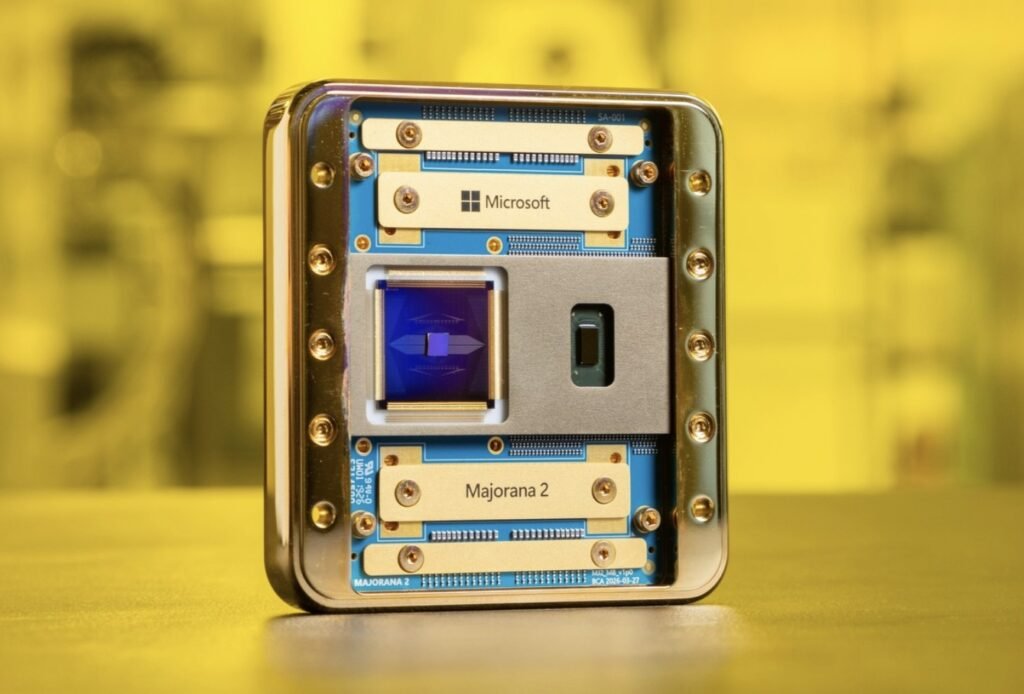
The chip’s qubits are claimed to be 1,000 times more reliable than those in Microsoft’s previous processor. The company reports a mean qubit lifetime of 20 seconds, with some instances lasting as long as one minute—far beyond the microsecond-scale lifetimes common in several other quantum approaches.
Majorana 2 uses a redesigned materials stack that replaces aluminium with lead and updates the semiconductor region. Microsoft says the changes strengthened the topological phase that protects quantum information from environmental noise and errors, while preserving microsecond-scale operations and a compact qubit size of about one-hundredth of a millimetre.
Agentic AI played a central role in the development effort. Research teams used Microsoft Discovery to analyse experimental results, investigate materials and coordinate scientific work, illustrating how AI systems may accelerate complex research rather than merely automate routine tasks.
On the strength of the latest results, Microsoft now expects to build a scalable quantum computer by 2029, cutting its earlier timeline in half. Such a machine could eventually support research in areas including health, energy, sustainability, food production and advanced materials, although reaching that goal will still require the technology to demonstrate reproducibility, error correction and scale.
Alongside the chip announcement, Microsoft said its Discovery platform is now generally available. The company also introduced a downloadable Discovery app that provides individuals with access to some core capabilities through a GitHub Copilot account.
Majorana 2 represents a significant company-reported engineering milestone, but its broader impact will depend on independent scrutiny and Microsoft’s ability to translate longer-lived qubits into a fault-tolerant system operating at commercial scale.
Sources: Microsoft News