Standing 25 centimetres tall and weighing about 780 grams, the duck shaped machine is available to preorder for USD $399 before taxes and shipping, with first deliveries targeted before Christmas 2026.
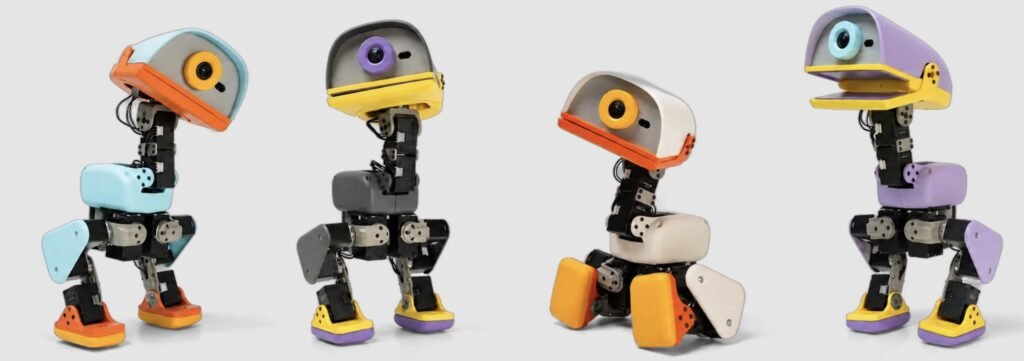
A small robot with serious ambitions
Microduck arrives ready to play, with an included game controller and seven trained movements. It can walk, sit, crouch, kick, scoop up small objects with its articulated beak, use roller skates and recover from many common falls.
Its body contains 15 motors, a wide angle camera, a compact LiDAR sensor and two motion sensing units, while onboard software runs its movement policies at 50Hz.
The headline feature is not a single trick, but the way new behaviours are created. Owners can train a movement policy in a physics simulator, deploy it to the real robot, refine the simulation and repeat. Finished behaviours can then be shared with the wider community.
What Microduck can do
Out of the box, Microduck can walk with a waddling gait, sit, stand, crouch, kick, collect small objects with its beak, move on optional roller skates and return to its feet after many common falls. Users can control the included behaviours with the supplied game controller or retrain movement policies to create new skills.
Potential use cases
- Robotics education: Students can explore balance, locomotion, sensors and control systems with hardware small enough for a classroom desk.
- Reinforcement learning research: Developers can train policies in simulation, test them on a physical robot and study the gap between simulated and real movement.
- AI prototyping: Teams can trial navigation, object collection, fall recovery and other physical behaviours before moving to larger, more expensive robots.
- Maker projects: Hobbyists can program original tricks, use the camera and depth sensing hardware in experiments, and share trained policies with the community.
- Demonstrations and workshops: Its compact size and ready made movements suit coding events, robotics clubs and public demonstrations of embodied AI.
- Entertainment: Owners can drive Microduck with the controller, set up movement challenges and experiment with accessories such as roller skates.
Open software lowers the barrier
Pollen Robotics positions Microduck as a practical platform for reinforcement learning and simulation to real deployment. Its robot control, simulation, software development kit and training tools are open source, allowing users to inspect, modify and publish software. The company notes that this openness applies to the software stack rather than the mechanical and electronic design files.
Pricing and availability
Every Microduck includes the robot, a removable battery, a USB C cable and a game controller. Four colours are planned at launch: Cream, Graphite, Lavender and Sky. Optional charger and developer packs add spare batteries, motors, cables, tools and training credit.
For Pollen Robotics, which is part of Hugging Face, Microduck extends its consumer robotics range beyond the desk based Reachy Mini. The new model focuses on action rather than conversation, offering a relatively affordable route into experiments that connect artificial intelligence with movement in the physical world.
Sources: Microduck official product page, Microduck official press kit