The Sony BRAVIA 7 II XR70M2 range is a premium 4K HDR television line built around Sony’s True RGB Mini LED backlight system and offered in 50, 55, 65, 75, 85, and 98-inch sizes. Positioned below the flagship BRAVIA 9 II, it is designed for viewers who want much of Sony’s latest colour, contrast, processing, gaming, and smart-TV technology across a broad spread of room sizes at a lower price point than the ultra-flagship tier.
What Makes the BRAVIA 7 II Different?
The headline feature is the True RGB Mini LED backlight. Instead of using a conventional blue or white LED system with a colour-conversion layer, the BRAVIA 7 II independently controls red, green, and blue LEDs. Sony combines this with RGB Backlight Master Drive Pro and local dimming to produce expanded colour volume, strong HDR brightness, and precise contrast control. Compared with the BRAVIA 9 II, the BRAVIA 7 II uses XR Contrast Booster 20 rather than XR Contrast Booster 40 and skips Sony’s strongest anti-reflection treatment, but it keeps the same core True RGB idea and X-Wide Angle Pro for more consistent colour from off-centre seats.
Key Features at a Glance
- Wide size range: 50, 55, 65, 75, 85, and 98-inch models, all with 3840 × 2160 resolution and a native 120 Hz refresh rate.
- True RGB Mini LED backlight: independently controlled red, green, and blue LEDs for richer colour and high brightness.
- XR Processor: AI-assisted scene analysis adjusts colour, contrast, clarity, and motion.
- Contrast control: RGB Backlight Master Drive Pro, XR Contrast Booster 20, and local dimming.
- Wide viewing technology: X-Wide Angle Pro helps colour and contrast remain consistent from wider seating positions.
- HDR support: HDR10, HLG, and Dolby Vision.
- Gaming: 4K at 120 Hz, VRR, ALLM, eARC, and Source-Based Tone Mapping over HDMI 2.1 features.
- Google TV with Gemini: streaming, recommendations, voice interaction, Google Cast, Apple AirPlay, and Apple HomeKit.
- Integrated audio: Acoustic Multi-Audio+ on larger sizes with Dolby Atmos and DTS:X support.
- Modern connectivity: four HDMI inputs, two USB ports, Ethernet, Bluetooth 5.3, and Wi-Fi 6E.
Picture Quality: Brightness, Colour, and Contrast
The BRAVIA 7 II is aimed at buyers who want a bright, colourful LCD television for mixed everyday use. The True RGB Mini LED system helps HDR highlights stand out while preserving more saturated colour than conventional Mini LED approaches. Local dimming and Sony’s processing support deep blacks and convincing contrast for movies, while XR Clear Image, Smooth Gradation, and XR Motion Clarity help streaming, broadcast TV, and fast sport look cleaner and smoother.
Picture modes include Vivid, Standard, Cinema, Professional, Calm, Photo, IMAX Enhanced, Dolby Vision options, and game-focused settings.
Movies, Streaming, and Smart TV Experience
Google TV brings major streaming services, personalised recommendations, watchlists, voice search, and app downloads into one interface. Google Cast and Apple AirPlay make it easy to share compatible content from phones, tablets, and computers, while Apple HomeKit, Google Assistant support, and Alexa compatibility provide smart-home flexibility. Gemini support adds more conversational discovery and assistance.
Film fans also benefit from Sony Pictures Core compatibility, Dolby Vision, IMAX Enhanced playback, and cinema-oriented picture presets, although app availability, voice features, and bundled offers can vary by country and account.
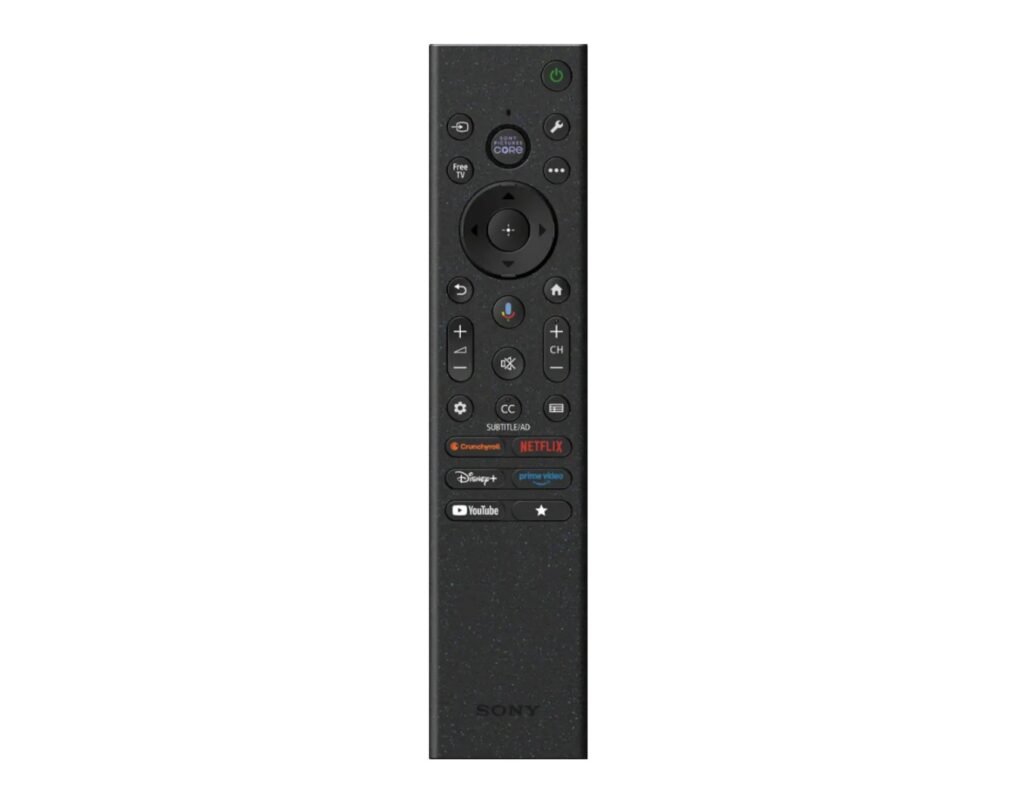
The BRAVIA 7 II uses Sony’s streamlined smart-TV remote approach, with quick access to power, volume, channels, inputs, settings, playback controls, and major streaming functions. Voice control works with Google TV, allowing users to search for films, open compatible apps, ask for recommendations, adjust selected settings, and control supported smart-home devices without navigating long menus. The remote’s simplified layout should be easy to learn, although viewers who regularly switch between broadcast TV, consoles, soundbars, and streaming boxes may still want to configure BRAVIA Sync and input shortcuts carefully.
Smartphone remote options
- Sony | BRAVIA Connect: on supported models, the app can provide power, input, volume, channel, and quick-settings controls, plus a touchpad interface for swipe-and-tap navigation.
- Google TV app: can turn a compatible Android or iOS phone into a basic remote for navigation and text entry.
- Same-network setup: the television and phone normally need to be connected to the same Wi-Fi network before pairing.
- Useful backup: a phone remote is convenient when the physical remote is misplaced and can make passwords or search terms easier to enter.
Practical considerations
- Complete the initial Google TV setup and install current software updates before assessing voice or app-remote performance.
- Enable HDMI-CEC/BRAVIA Sync if you want the Sony remote to control compatible soundbars, receivers, disc players, or streaming devices.
- Keep voice-services and account privacy settings aligned with your household preferences.
- Confirm app compatibility for the BRAVIA 7 II in your region, because Sony’s supported-device lists and app functions can change.
Gaming Features and HDMI Considerations
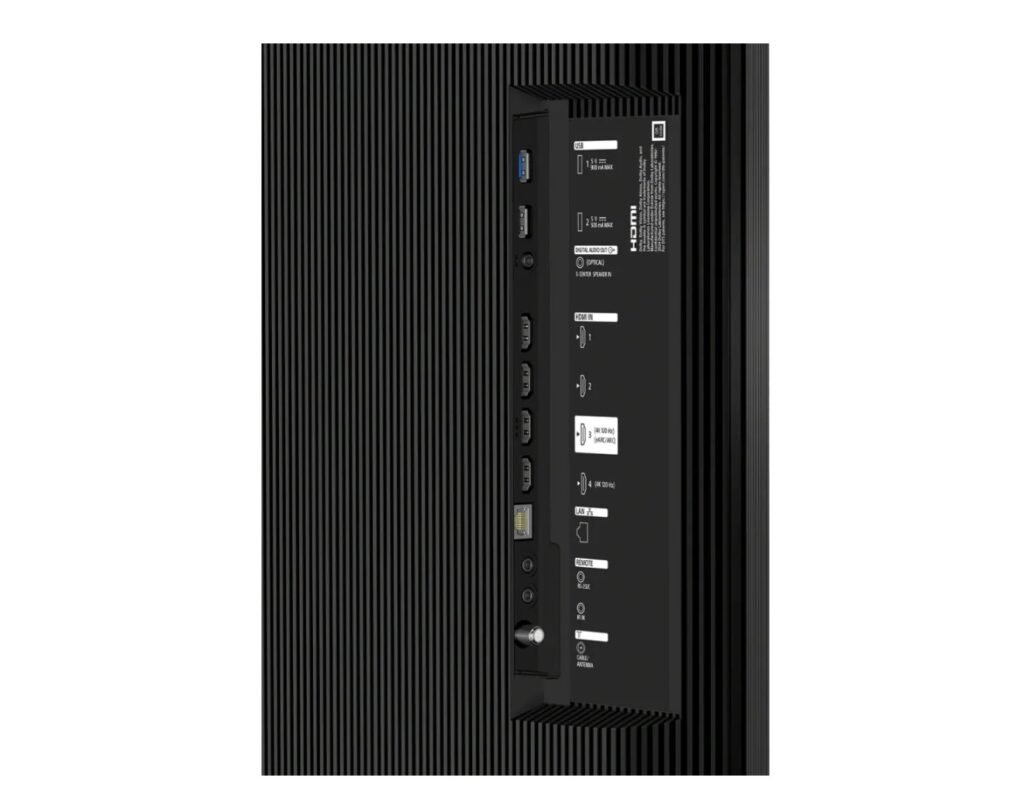
For PlayStation 5, Xbox Series X, and gaming PC users, the television supports 4K/120 Hz, Variable Refresh Rate, Auto Low Latency Mode, and Source-Based Tone Mapping. VRR is available on HDMI inputs 3 and 4, while ALLM is supported across all four HDMI inputs. Because eARC shares the HDMI feature set, buyers connecting multiple current-generation consoles plus a soundbar or receiver should plan their ports carefully. The native 120 Hz panel is well suited to console gaming, but it is not aimed at high-refresh PC players seeking 144 Hz or higher operation.
Audio and Home-Theatre Integration
Sony equips the 50- and 55-inch BRAVIA 7 II models with Acoustic Multi-Audio, while the 65-, 75-, 85-, and 98-inch models step up to Acoustic Multi-Audio+. The 50- through 85-inch models use a 40-watt audio system, and the 98-inch model increases total output to 65 watts. Speaker layouts also vary by size: the 50- and 55-inch models use full-range speakers and tweeters, the 65-, 75-, and 85-inch models use full-range speakers and subwoofers, and the 98-inch model adds a larger full-range speaker array with subwoofers. Across the range, the television supports Dolby Atmos, DTS:X, Voice Zoom 3, acoustic auto calibration, 3D surround upscaling, and S-Master digital amplification. Owners of compatible Sony soundbars can use Acoustic Center Sync and BRAVIA Theatre integration for a more cohesive front soundstage.
Design, Placement, and Installation
The BRAVIA 7 II is available in six sizes: 50-inch, 55-inch 65-inch, 75-inch, 85-inch, and 98-inch. Dimensions and weight rise sharply through the range: the 50-inch model is a manageable furniture or wall-mount option, the 65-inch size is a strong living-room middle ground at about 1447 × 907 × 341 mm with stand and 30.7 kg with stand, and the 98-inch model becomes a specialist large-screen installation at roughly 2180 × 1315 × 540 mm with stand and 67.2 kg with stand. VESA patterns also vary, from 200 × 200 mm on the 50-inch model to 600 × 400 mm on the 98-inch model.
Detailed Specifications
| Category | Specification |
| Model | Sony BRAVIA 7 II range |
| Model year | 2026 |
| Screen size | 50-inch: 50-inch class, 49.5-inch measured diagonal / 126 cm 55-inch: 55-inch class, 54.6-inch measured diagonal / 139 cm 65-inch: 65-inch class, 64.5-inch measured diagonal / 164 cm 75-inch: 75-inch class, 74.5-inch measured diagonal / 189 cm 85-inch: 85-inch class, 84.6-inch measured diagonal / 215 cm 98-inch: 98-inch class, 97.5-inch measured diagonal / 248 cm |
| Display type | LCD with RGB LED / True RGB Mini LED backlight and local dimming |
| Resolution | 3840 × 2160 pixels, 4K UHD |
| Native refresh rate | 120 Hz |
| Viewing and glare technology | X-Wide Angle Pro; no X-Anti Reflection listed |
| Picture processor | XR Processor with AI scene recognition |
| Colour technology | RGB TRILUMINOS Max; Live Color Technology |
| Contrast and backlight control | RGB Backlight Master Drive Pro; XR Contrast Booster 20; Dynamic Contrast Enhancer |
| Clarity and motion | XR Clear Image; Smooth Gradation; XR Motion Clarity |
| HDR formats | HDR10, HLG, Dolby Vision |
| Smart TV platform | Google TV with Gemini |
| Casting and smart home | Google Cast built-in, Apple AirPlay, Apple HomeKit, Google Assistant, Alexa compatibility, BRAVIA Sync/HDMI-CEC |
| HDMI inputs | 4 side-facing HDMI inputs; HDCP 2.3 |
| HDMI 2.1 features | 4K/120 Hz, eARC/ARC, VRR, ALLM, SBTM; VRR on HDMI 3 and 4 |
| USB ports | 2 side-facing USB ports |
| Network connections | Ethernet LAN; Wi-Fi 6E supporting 2.4, 5, and 6 GHz bands |
| Bluetooth | Bluetooth 5.3; A2DP, AVRCP, HID, HOGP, and SPP profiles |
| Tuner input | 1 terrestrial/cable RF input; regional tuner features vary by market |
| Digital audio | 1 digital audio output, shared with S-Center Speaker input |
| Built-in audio | Acoustic Multi-Audio+ on 65-inch and larger models; 40 W total output on 50–85-inch models, 65 W on 98-inch model |
| Speaker configuration | 65, 75, and 85-inch: 2 full-range speakers and 2 subwoofers; 98-inch: 4 full-range speakers and 2 subwoofers; 50- and 55-inch: 2 full-range speakers and 2 tweeters |
| Audio formats and features | Dolby Audio, Dolby Atmos, DTS Digital Surround, DTS-HD, DTS:X, Voice Zoom 3, acoustic auto calibration, 3D surround upscaling |
| TV dimensions with stand | 50-inch: 1114 × 720 × 183 mm 55-inch: 1228 × 784 × 209 mm 65-inch: 57 × 35.75 × 13.5 in / 1447 × 907 × 341 mm 75-inch: 1671 × 1034 × 386 mm 85-inch: 1895 × 1159 × 441 mm 98-inch: 2180 × 1315 × 540 mm |
| Stand footprint | 50-inch: 481 × 79 × 183 mm; stand width 481 mm 55-inch: 13 5/8 × 3 1/8 × 8 1/4 in / 343 × 79 × 209 mm; stand width 343 mm 65-inch: 13.63 × 3.25 × 13.5 in / 343 × 80 × 341 mm; stand width 343 mm 75-inch: 343 × 81 × 386 mm; stand width 343 mm 85-inch: 443 × 81 × 441 mm; stand width 443 mm 98-inch: 1851 × 72 × 540 mm; stand width 1851 mm |
| Weight with stand | 50-inch: 19.3 kg 55-inch: 47.2 lb / 21.4 kg 65-inch: 67.7 lb / 30.7 kg 75-inch: 42.1 kg 85-inch: 53.6 kg 98-inch: 67.2 kg |
| Weight without stand | 50-inch: 15.7 kg 55-inch: 40.6 lb / 18.4 kg 65-inch: 58.6 lb / 26.6 kg 75-inch: 36.6 kg 85-inch: 45.9 kg 98-inch: 62.2 kg |
| VESA mount pattern | 50-inch: 200 × 200 mm 55-inch: 300 × 300 mm 65-inch: 300 × 300 mm 75-inch: 300 × 300 mm 85-inch: 400 × 400 mm 98-inch: 600 × 400 mm |
Who Is It Best For?
- Bright-room viewers: strong brightness helps with daytime TV, sport, and general living-room use, with sizes available from compact premium rooms to very large spaces.
- Movie enthusiasts: True RGB colour, local dimming, Dolby Vision, and cinema modes support a polished home-theatre experience, especially in the 75-, 85-, and 98-inch sizes.
- Sports fans: the 120 Hz panel and XR Motion Clarity help fast action look smooth and readable.
- Console gamers: 4K/120 Hz, VRR, ALLM, and PlayStation-friendly features cover current-generation gaming needs.
- Value-focused premium buyers: it offers much of Sony’s 2026 True RGB experience without stepping up to the BRAVIA 9 II flagship price, while letting buyers choose a size that fits their room and installation budget.
Potential Drawbacks to Consider
The BRAVIA 7 II is still a premium television, so budget-conscious buyers may find cheaper Mini LED alternatives. It also lacks the stronger anti-reflection treatment listed on the BRAVIA 9 II, which means dark scenes may be harder to see in very bright rooms with direct reflections. Only HDMI inputs 3 and 4 support VRR, so gamers with several high-bandwidth devices and an eARC sound system should plan their connections. The 120 Hz ceiling is excellent for consoles but less attractive to PC gamers seeking higher refresh rates. Buyers considering the 75-, 85-, and especially 98-inch versions should also factor in furniture strength, wall-mount compatibility, delivery access, and installation labour. As with any local-dimming LCD, difficult high-contrast scenes may still show some haloing compared with self-emissive OLED panels.
The 50 and 55-inch models suit smaller premium spaces, the 65 and 75-inch versions hit the mainstream living-room sweet spot, and the 85 and 98-inch models move into serious home-cinema territory.
It does not have every premium feature of the BRAVIA 9 II, especially in contrast boosting and reflection handling, but that is exactly what helps make it the more approachable choice. For many households, the BRAVIA 7 II may be the better-balanced Sony upgrade than stepping all the way to the flagship.